
You didn’t just fall in love. You fell into a chemical storm.
In the beginning, you couldn’t keep your hands off each other. You stayed up until 3 a.m. talking. The anticipation of a text message sent shivers down your spine.
But fast forward five, ten, or twenty years, and that electric current has been replaced by a comfortable, predictable, and frankly, boring hum.
You love your partner, but the “want” has quietly left the building.
We are here to tell you two things:
First, this is not your fault. It is a biological inevitability we’re calling The Passion Plague.
Second, and more importantly, you do not have to accept this decline in passion as a given.
Biology may have cooled the fire, but neuroscience provides the match to rekindle the flame.
Part 1: Diagnosing The Passion Plague
Why Long-Term Love Naturally Loses Its Spark
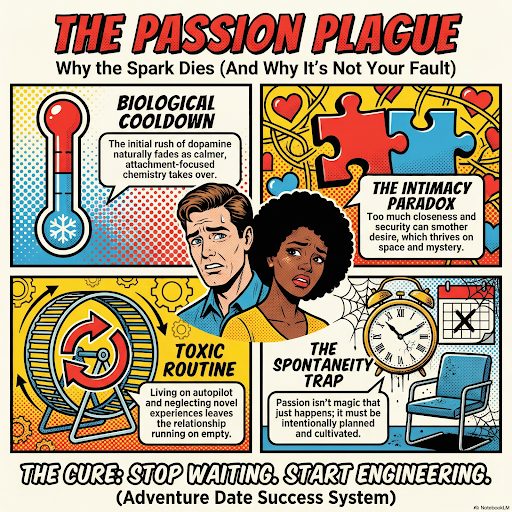
If you feel like you are living in a “post-sex” marriage or that you have morphed into efficient business partners managing a household, you may have fallen victim to this Passion Plague.
You’re facing natural headwinds the longer you’re in a relationship. Knowing some of the common causes of this desire entropy can empower you…
Make it so you stop pointing fingers at yourself or your partner for “failing.”
A. The Biological Cooldown (The Neurochemical Bait-and-Switch of Long Term Love)
Nature played a trick on you. In the early days, your brain was flooded with dopamine (the craving and motivation chemical) and norepinephrine (heightening your focus and energy). You were literally high on your partner, activating the Ventral Tegmental Area (VTA) of your brain – the same region that lights up for cocaine.
But the brain cannot sustain that frenzy forever. Over time, that thrilling dopamine rush is replaced by Oxytocin, (the “bonding hormone”) responsible for deepening attachment, trust, and security.
While this shift makes your relationship stable, it also has the tendency to make it boring. After all, evolution prioritizes child-rearing safety over mating frenzy, meaning your brain trades “hot” for “safe.”
Your relationship didn’t die; it just got sedated. You are suffering from a dopamine deficit, and those standard “dinner and a movie” dates simply aren’t ever going to be the fix.
B. The Intimacy Paradox Here is the uncomfortable truth: Closeness can kill desire.
Over the years we become “best friends” with our partners, merging our lives until there is no mystery left.
But as the science shows, desire needs space to breathe. Attraction thrives on uncertainty and “otherness”… seeing your partner as a separate, self-sustaining individual rather than a predictable extension of yourself.
When a partner becomes entirely predictable, the brain stops releasing dopamine because the reward is guaranteed. The spark is smothered with safety, your partner becomes a roommate who happens to sleep in the same bed.
To want them again, you must psychologically create a gap… you need to make them a stranger again so there is something left to discover. Yum!
C. The Myth of Spontaneity
Perhaps the most damaging symptom of the Passion Plague is the belief that passion should just “happen” naturally. In long-term bonding, the spontaneous drive system quiets down.
Waiting for lightning to strike usually results in a sexless drought because long-term desire is not spontaneous; it is responsive and premeditated.
Think about it: You schedule your dentist, your gym, and your business meetings. Why do you leave the most important relationship in your life to chance?
“Spontaneous” is a myth that keeps you lonely and feeling like something is wrong or you’re broken.
Real passion, sustainable passion, lifelong passion is engineered.
Part 2: The Science of Passion
How to Hack Your Biology and Sustain “New Love” Energy
Here is the secret that changes everything: The “honeymoon phase” isn’t a magical time period that expires after 18 months; it is a specific brain state.
For decades, we believed that the intense romantic love of early courtship inevitably fades into companionate love. However, groundbreaking fMRI studies on couples married an average of 21 years have shattered this myth.
Researchers found that some long-term couples show the exact same activation in the Ventral Tegmental Area (VTA)—the brain’s dopamine-rich reward center—as teenagers who just fell in love.
The fire doesn’t have to go out. It just needs fuel.
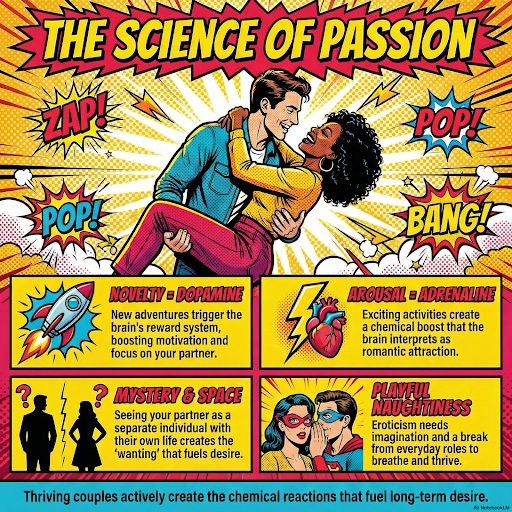
By leveraging the Science of Passion, we can trigger the brain’s reward system on command. We can engineer the “butterflies” using specific triggers that wake up your nervous system.
Here’s the secret ingredients to passion on demand…
A. The Dopamine Rush (The Novelty Trigger) The brain ignores the familiar. To wake up the libido, you must introduce Novelty.
When you engage in new, challenging activities together, you trigger the brain’s “self-expansion” mechanism, releasing dopamine which the brain then associates with your partner.
The Shift: Imagine looking at your partner and feeling that nervous, excited “first date” energy again. It’s not magic; it’s developing the skills of Adventure Dating. A practice where you inject novelty into your romantic experiences. You aren’t just going out; you are activating your neurochemistry to build the heat..
B. The Adrenaline Boost (Obstacles are hot!)
Psychological research confirms that high-arousal activities (fear, excitement, physical exertion) trick the brain. The pounding heart caused by an adventure is chemically misinterpreted by the brain as sexual attraction toward the person next to you.
The Shift: Stop playing it safe. When was the last time your hearts raced together?
When you introduce “safe danger” or consciously curated “Obstacles” into your dating life, you turn anxiety into aphrodisiacs. For example, Romeo and Juliet’s intense desire was accelerated because of the war between their families. They were forbidden to see each other.
You don’t need to start an inner family feud to play this game, but you can learn the art of creating playful obstacles to inspire arousal and desire.
C. The “New Eyes” Effect (The Mystery Trigger)
Recent EEG studies show that when we perceive someone as attractive, our brains exhibit a specific pattern called “alpha and lower-beta event-related desynchronization” (ERD). This is the brain saying, “Pay attention, this is important!”
Routine dampens this signal.
We often think intimacy means knowing everything about our partner, but as relationship expert Esther Perel notes, “desire needs space”.
Biologically, this space allows for the detection of subtle chemical signals that get drowned out by routine. Research in Social Cognitive and Affective Neuroscience suggests that specific chemosignals (like estratetraenol) can actually heighten sexual cognition and emotional reaction to touch.
When we are too close, we become desensitized. When we create distance, or Mystery, we re-sensitize our nervous system to these biological cues.
The Shift: If you are merged at the hip, there is no bridge to cross, no yearning for, only already having. Boring! The brain craves more what it can’t have.
You need to shock your brain out of “auto-pilot.” By using specific techniques like Sensory Deprivation (blindfolds) or Chemosignaling (maximizing scent triggers that heighten emotional reaction to touch), you force your brain to re-evaluate your partner as a high-value mate.
By cultivating mystery, perhaps by withholding the details of an upcoming date night or engaging in independent passions, you become a puzzle your partner wants to solve rather than a book they have already read.
Invite them to “look at you with new eyes”.
PART 3: The Vision: Engineering Your Epic Love
Mystery, Obstacle, and Novelty (Or Naughtiness), what we call The Passion Trifecta, are the kindling that fuel lifelong desire.
We’ve been fed the myth that passion should be spontaneous, but the most erotic couples understand that in a long-term relationship, “committed sex is premeditated sex”.
They don’t leave their desire to chance; they design it.
Understanding how to use Mystery, Obstacle and Novelty to inspire passion is the difference between a relationship that survives and one that ripples with hot, magnetic attraction.
Are you ready to design your own epic, life-long love affair?
How could you apply The Passion Trifecta in your relationship today?
Jaiya and I had found ourselves in a dying relationship after the birth of our son.
Perhaps like you, we loved each other, but the heat was gone.
We knew there must be a way to fall back in love, so we applied the principles discussed in this article and built a framework to take back control.
Our ‘Adventure Date Success System’ gave us the tools to make it happen, and you can do it too!
Whether your goal is to make sure that “new love” feeling never fades or you want to transform from “roommates” to “lovers” again, the scientific principles embedded in our program give you what you need to succeed.
Stop relying on old habits and start actively using the Passion Trifecta to unlock the dormant passion potential of your relationship.
The capacity for epic, everlasting love is already hardwired into your brain.
You just need the right keys to unlock it. Check out The Adventure Date Success System and have a blast falling in love all over again!
With great pleasure,
Ian